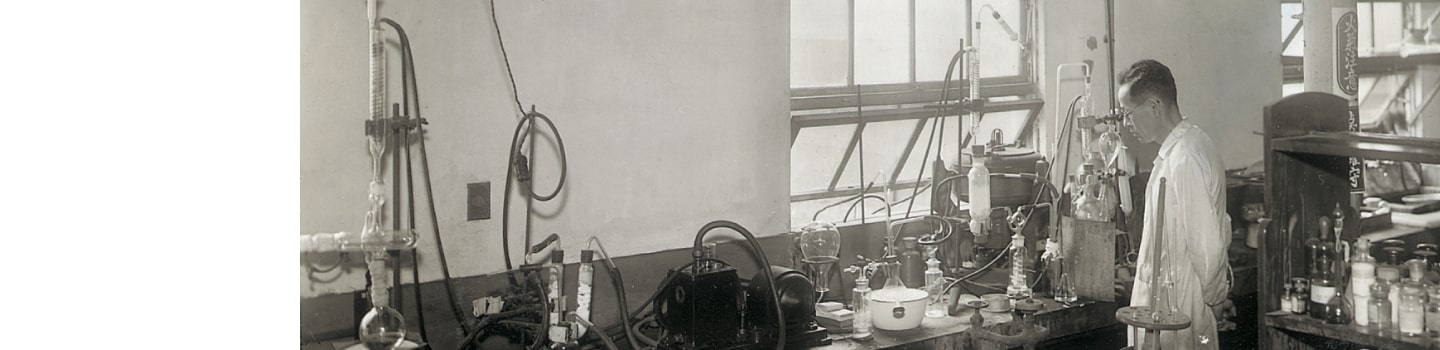
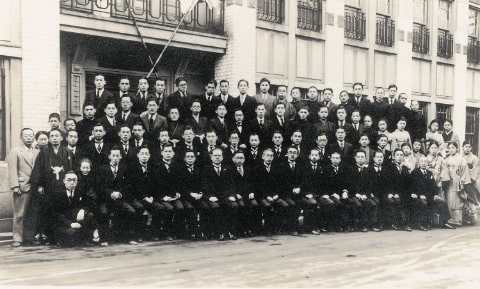


Santen’s origins date back to 1890, when Kenkichi Taguchi opened Taguchi Santendo. Heburin-gan, a cold medication, was its main product at the time. In the late 19th century, many people in Japan suffered from eye disorders, and demand for eye drops was high. The company launched Daigaku Eye Drops in 1899 and the product’s popularity spread nationwide. From that point, Santen began taking on the challenge of contributing to eye health.
Founded in Osaka in 1890, we have continued to evolve our selection and concentration in the field of eye health, creating and innovating to meet the unmet needs of people and society.
Santen was founded in Osaka in 1890 and launched “Daigaku Eye Drops” in 1899 as Santen’s first eye care product. At the time, many people in Japan were suffering from eye diseases, and this product quickly became available throughout the country. In the 1950s, Santen entered the prescription pharmaceutical business.
In 1990, when Santen celebrated its 100th anniversary, we embarked on a new path of growth. In addition to growing our business in Japan by expanding our product lineup and completing construction of new plants and laboratories, Santen expanded into the European market to extend our contribution to improving the eye health of patients worldwide. To meet the needs of more people, Santen built a business base in Asia in the 2000s, establishing its own sales network and production plant in China. Since 2010, Santen has continued to expand its business in Asia and Europe.
Establishment—Laying the Foundation Growth (1890–1989)
1890 Santen kicks off by taking the challenge of contributing to people’s health


1950s Pursuing a strategy centered on eye drops, and expanding into prescription pharmaceuticals
Due to difficulties encountered from aerial bombings during World War II, Santen shifted its business strategy focusing on eye drops. In 1958, Santen entered the prescription pharmaceutical business and in 1962 launched Mydrin-P, which promotes mydriasis, or dilation of the pupil. This groundbreaking eye drop used in ophthalmic surgery and diagnosis contributed significantly to the development of ophthalmology in Japan. Thereafter, product launches included an innovative antibiotic ophthalmic and a glaucoma treatment, laying the foundation to support ophthalmic treatment in Japan.

Growth (1990–2009)
1990s Strengthening the global production system toward internationalization and entering the European market
Upon its centennial in 1990, Santen embarked on a new growth stage with the announcement of a long-term vision to contribute to society with the best products and services focusing on the eye and health. In addition to business growth in Japan on the back of an expanding product lineup, and the completion of the Shiga Plant, Santen entered the European market and emphasized aggressive business development to contribute to patients around the world.

2000s Expanding solutions and building a business foundation in Asia
Santen focused on meeting the needs of more people by providing a wide range of treatment options including intraocular lenses and supplements in addition to ophthalmic solutions for eye diseases. At the same time, the Company worked to build a business foundation in Asia, which included building a direct sales network in China as well as completing the Suzhou Plant, and establishing Group company in South Korea.

Transformation (2010–)
2010s Rapidly accelerating globalization to contribute to eye health worldwide
Aiming to become a specialized pharmaceutical company with a global presence as its long-term vision up to 2020, Santen rapidly accelerated its globalization, centered on China, Asia and EMEA. In 2015, Santen sold its anti-rheumatic pharmaceuticals business to AYUMI Pharmaceutical Corporation to specialize in ophthalmology and concentrate its management resources in the field.

2020s Toward realizing Happiness with Vision for people around the world
Aiming to resolve eye-related social issues, the Company announced a medium-term management plan with a view toward the future of the world. To realize “The Happiest Life for every individual through the Best Vision Experience,” Santen continues to take on challenges worldwide to provide products and services with true value by bringing together knowhow and expertise through partnerships with external organizations, M&A and other approaches.