Sore, Dry or Heavy Eyes After Prolonged Screen Time? It May Be a Sign of Something More.
The truth about dry eye disease you should know.
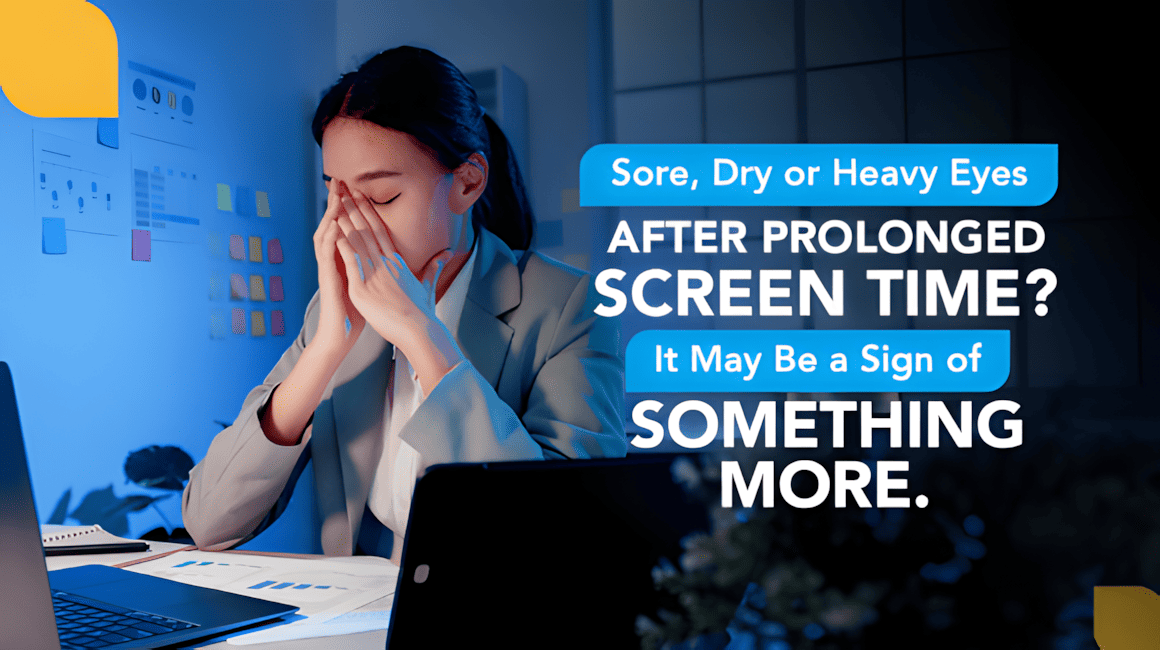
Notice your eyes feeling sore, dry, or heavy after staring at a screen for too long? Many people think it’s normal, but it can actually be a sign of something more serious. What starts as simple eye strain may develop into Dry Eye Disease (DED).
While there are many causes of DED, our screen-filled lifestyle plays a major role in triggering or worsening the condition.
In today’s world, screens are everywhere. We work on laptops for hours, then scroll through our phones during breaks. Our eyes rarely get the rest they need, and over time, this constant strain can cause dryness and irritation.
If you often experience any of these symptoms, your eyes may be trying to tell you something:
- Itching eyes
- Burning
- Soreness or tiredness
- Redness
- Blurred vision
What’s Going Wrong When Your Eyes Can’t Stay Moist?
Your eyes are protected by a thin layer called the tear film, which keeps the surface smooth and moist. When this layer becomes unstable or damaged, moisture evaporates too quickly, and your eyes lose their natural protection. Unlike a headache that fades with rest, dry eyes often do not heal on their own and can get worse if left untreated.
Break the Cycle—Give Your Eyes the Care They Deserve

Once the tear film breaks down, inflammation can develop and reduce tear production even more. This creates a cycle where dryness and irritation keep coming back. The good news is that a few simple habits can help break this cycle:
- Use lubricating eye drops
Use lubricating eye drops when your eyes feel dry.
- Apply a warm compress
Apply a warm compress and gently clean your eyelids daily.
- Follow the 20-20-20 rule
Every 20 minutes, look at something 20 feet away for 20 seconds.
Most importantly, visit an eye doctor if your symptoms keep bothering you. They can prescribe eye drops to treat dry eye disease.

Your eyes work hard every day and deserve care just like the rest of your body. Give them rest, keep them moist, and seek help when you need it.
Reference:
Huang, P. (n.d.). Understanding dry eye disease [Video]. DOL.
Messmer, E. M. (2015). The pathophysiology, diagnosis, and treatment of dry eye disease. Deutsches Ärzteblatt International, 112(5), 71–82. https://doi.org/10.3238/arztebl.2015.0071