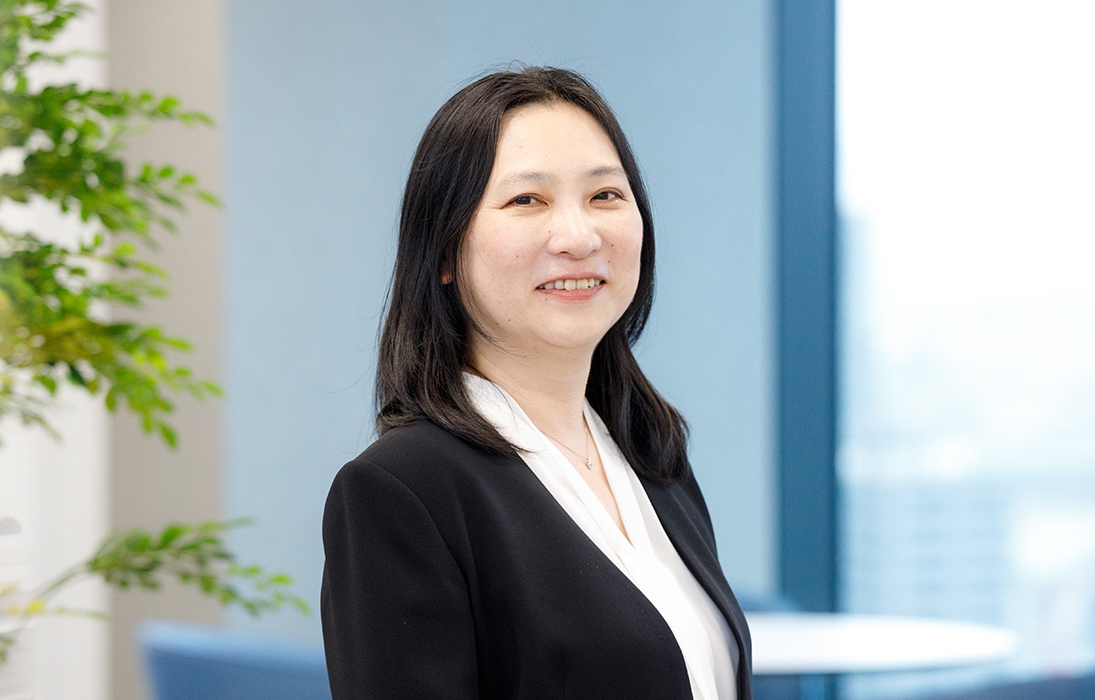
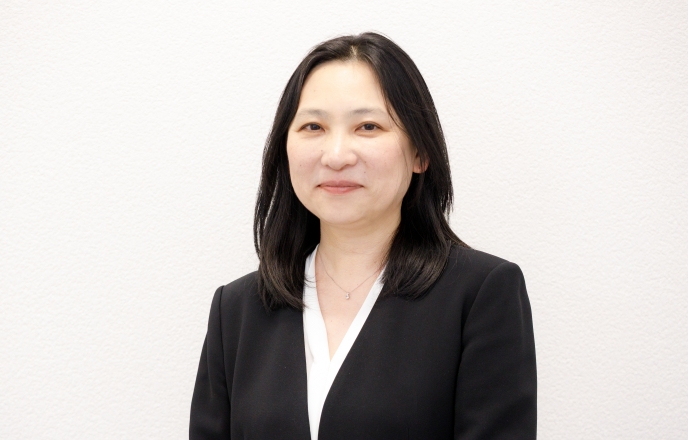
Maya Inai
Clinical Manager, Clinical Operations Japan/Asia Group Product Development, R&D
Joining Santen in 2001, Maya Inai transferred to Clinical Development after working in the Research Department. Since then, she has focused on clinical development activities and currently serves as a Clinical Manager, overseeing clinical trial management in Japan and the Asia-Pacific region.
Her hobby is visiting hot springs, where she cherishes time spent relaxing while enjoying great food.
Before a new drug reaches patients, pharmaceutical companies spend many years engaged in a multi-step research and development (R&D) process. The success of this R&D process relies heavily on the cooperation of external stakeholders, including medical institutions, and the expertise of specialists from a variety of fields.
The focus of this article is Clinical Development—the final step in Santen’s R&D process—so we sat down with Clinical Manager Maya Inai from Santen’s Clinical Operations Japan/Asia Group to learn more about the principles that guide this critical activity.
Final Step in Turning Research-Driven Potential into “Safe-to-Use Medicines”
―What is the role of clinical development in the R&D process?
Clinical development is responsible for conducting clinical trials that administer investigational drugs to study participants in order to evaluate their safety and efficacy.
When a pharmaceutical company submits an application for marketing approval to the relevant regulatory authority, the data obtained during clinical trials serves as evidence regarding a drug's safety and efficacy.
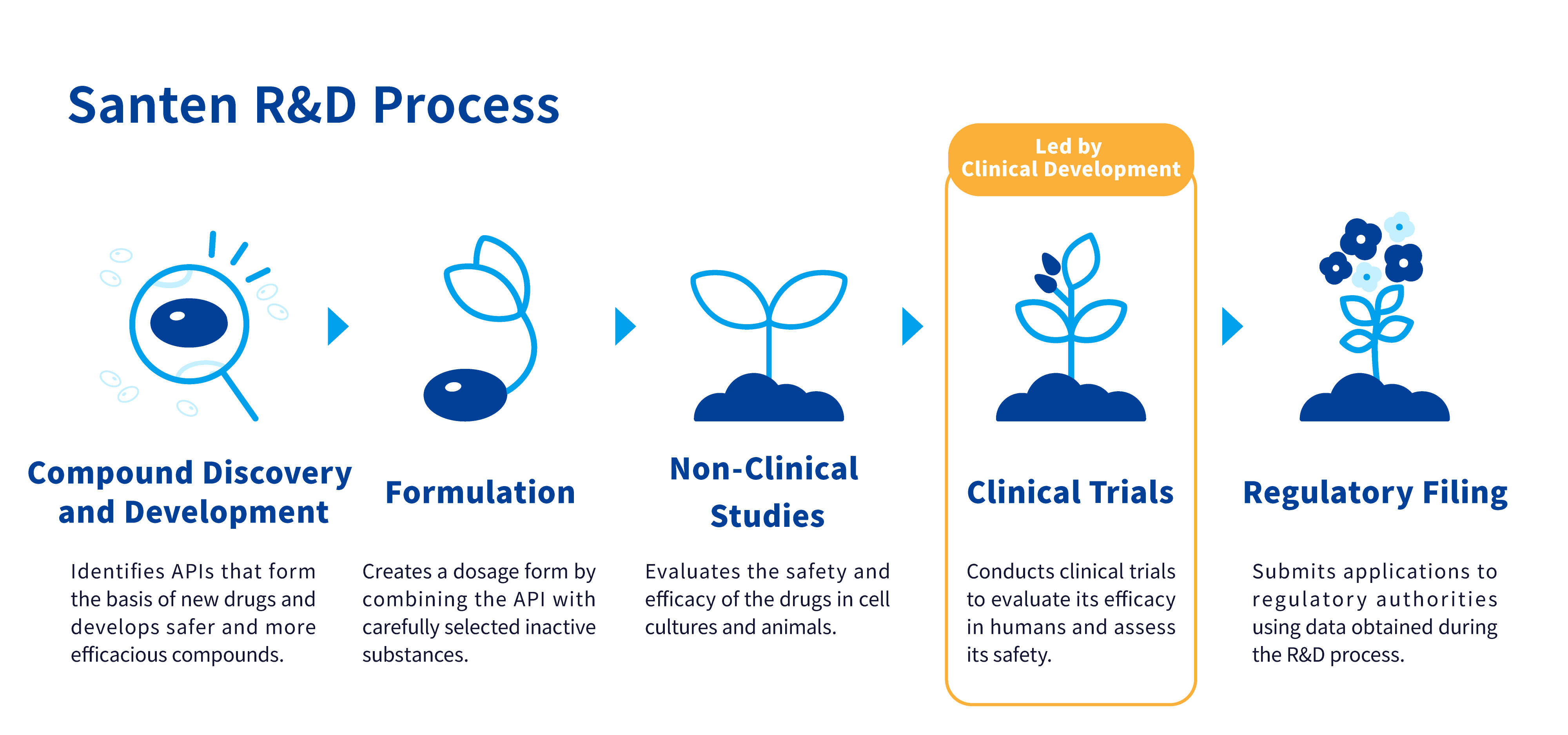
Santen’s multi-stage R&D process involves various departments within the company. Compound Discovery and Development identifies compounds that will serve as the active ingredients in drugs; Formulation designs a finished drug product based on the active pharmaceutical ingredient (API) for use by patients; Non-Clinical Development uses cell cultures and animals to evaluate drug safety and efficacy; and Regulatory Affairs handles various procedures, including regulatory filings. Clinical Development plays a pivotal role in the final stage of the R&D process, ensuring that all of this work leads to regulatory approval and ultimately brings safe and effective medicines to market.
―What exactly happens during a clinical trial?
Clinical trials are conducted through a network of participating medical institutions. A drug that has been determined to be suitable for treating a particular disease based on the results of non-clinical studies conducted in a laboratory will be administered to participants in a clinical trial. Participants typically include healthy individuals and patients recruited through public recruitment, as well as patients who have consented to participate in clinical trials at participating medical institutions. All participants receive a detailed explanation of the trial and provide their informed consent. Clinical data are then collected after administration to verify the drug’s efficacy and evaluate its safety.
A clinical trial begins with a small number of initial participants and we continuously assess the drug’s safety while gradually expanding the study population. Safety and efficacy are often evaluated by comparing outcomes from use of the investigational drug with those resulting from use of existing drugs or a placebo*.
If the data collected during the clinical trial stage is not sufficiently reliable, then regulatory authorities will not approve the drug. Furthermore, use of clinical data that has not been subjected to thorough analysis could pose a health risk for patients. Clinical Development’s mission is to prevent this from happening, and we do this by ensuring that clinical trials are conducted properly.
* Placebo: A treatment that contains no active ingredients. In clinical trials, a placebo is used as a control group to objectively evaluate the efficacy of an investigational drug.
Collecting Reliable Data Based on Meticulous Planning, Verification, and Assessment
―Can you describe your work?
I have been involved in clinical development at Santen for more than 20 years. My experience relates chiefly to the day-to-day process of launching and conducting clinical trials, and I currently serve as a clinical manager, overseeing the management of clinical trials conducted in Japan and across the Asia-Pacific region.
The primary responsibility of a clinical manager is to plan and execute clinical trials in collaboration with the drug development and non-clinical development teams. Since clinical development is conducted on a global scale, trials intended for approval and distribution outside of Japan must be designed in accordance with the regulatory requirements and standards of each region. This means that I have frequent opportunities to communicate in English with overseas staff who are well-versed in local regulations and other relevant matters.
Each trial is conducted by a monitor (a staff member responsible for managing and overseeing the trial’s progress), who visits the participating medical institutions and coordinates with doctors and medical staff. Meanwhile, the clinical manager reviews the data submitted by the monitor, makes decisions when unexpected issues arise, and coordinates the flow of information. Another important task is compiling the data required for regulatory submission after the trial has concluded.

The clinical trial protocol describes the requirements for conducting a clinical trial
―What kinds of situations really test a clinical manager’s skills?
The detailed planning that takes place prior to the start of a clinical trial, and when responding to unforeseen circumstances that may arise after the trial has begun.
Numerous factors need to be considered before a clinical trial begins. These include how to recruit patients and how many participants to include; the number of study materials to be delivered; how to store them at the hospital; the dosage and administration of medications; and the testing methods and evaluation criteria. Taken individually each of these decisions may seem minor, but all of them directly impact the patient burden, the safety of the trial, and the reliability of the data obtained.
Increasing the number of tests can yield more accurate data, but it also places a greater burden on healthcare providers. On the other hand, if the number of tests is too small, then getting reliable data will be impossible. And while short intervals between hospital visits can be burdensome for patients, if the intervals are too long, then it becomes difficult to adequately evaluate the safety of the drug after it has been administered.
There is no single correct answer; each situation is unique and depends on the type of condition, the medical facility involved, and the patient. Therefore, we make decisions on a case-by-case basis, working as a team to refine our plans while balancing three critical factors: patient safety, the burden on medical staff, and data reliability.
No matter how meticulously we plan, we often have to make real-time decisions once the trial begins. To address this, we clearly define our decision-making criteria to ensure consistency across all locations. Furthermore, during the trial, we maintain a high level of vigilance by communicating closely with team members and reviewing daily data to ensure that any anomalies are spotted immediately.
Earning the Trust of Medical Institutions by Seeing Things from Their Perspective
―What aspect of your work do you value the most?
Putting yourself in the other person’s shoes.
For pharmaceutical companies, clinical trials are an essential process for bringing drugs to market, but they place a burden on participating medical institutions and trial participants. Neither medical institutions nor patients are likely to agree to cooperate unless they trust the pharmaceutical company. Which is why we must not unilaterally impose any demands on either group.
When I was working onsite at medical institutions as a Santen clinical monitor, I would sometimes find myself advocating for the institutions’ interests and trying to persuade my colleagues back in the office. Now, as a manager, there are times when I have to negotiate with medical institutions while advocating on behalf of the company. However, I always make a point of putting myself in the other party’s shoes, listening to their opinions, and responding with sincerity.
―Do you get a sense of Santen’s strengths during the clinical trial process?
At times I can really feel the deep trust that ophthalmologists place in us. For example, in my interactions, I have observed constructive collaboration with ophthalmologists, which supports effective communication and conduct during clinical trials. I believe these interactions reflect our long‑standing focus on ophthalmology and ongoing communication with physicians.
Focus on Essentials and Act Accordingly— “Nothing Happened” is the Best Outcome
―When do you feel a sense of fulfillment or accomplishment in your work?
I get that feeling when a trial proceeds smoothly and is completed on schedule.
Clinical trials are planned and conducted in accordance with international guidelines known as Good Clinical Practice (GCP), and are subject to notifications to and approvals from the government, as well as ethical review by participating medical institutions. While there are rules and standards that must be followed, the way a trial is conducted varies from drug to drug, and even with careful planning, unforeseen circumstances can arise.
Once a clinical trial begins, the clinical manager’s role primarily involves handling “unforeseen circumstances.” So the less I need to step in the better it is for everyone. After all, that’s the ultimate proof that patient safety is being maintained, that the clinical setting isn’t being overburdened, and that the trial is proceeding smoothly.
―What are your future goals?
I am committed to ensuring that the results of our R&D process, involving a variety of departments, are accurately communicated to patients. To that end, I will continue to approach the design and implementation of clinical trials with the utmost priority on “patient rights and safety,” as emphasized by GCP.
Since its founding, Santen has focused on specialized fields centered on ophthalmology, and through our pursuit of intrinsic value, we have continued to contribute to patients and their loved ones. That spirit has naturally become a part of me as well. I am committed to approaching every task with integrity and supporting the development of medicines in line with established safety and quality standards.
Disclaimer: This article is intended for informational purposes only and reflects personal experiences in clinical development. It does not promote any specific product or treatment.