Professor Asa Ito from the Institute for Future Society Creation/Institute for Liberal Arts Education at the Institute of Science Tokyo conducts research into diverse physical states, perception, and human relationships through interviews with people with disabilities. Her 2015 book, How Do People Who Are Blind See the World? (publisher: Kobunsha Shinsho), now in its 25th printing, has significantly changed society’s understanding of visual impairment.
Santen spoke with Professor Ito about what is needed to create an organization that truly harnesses diversity, transcending differences in attributes such as disability status, age, gender, and nationality, among others.
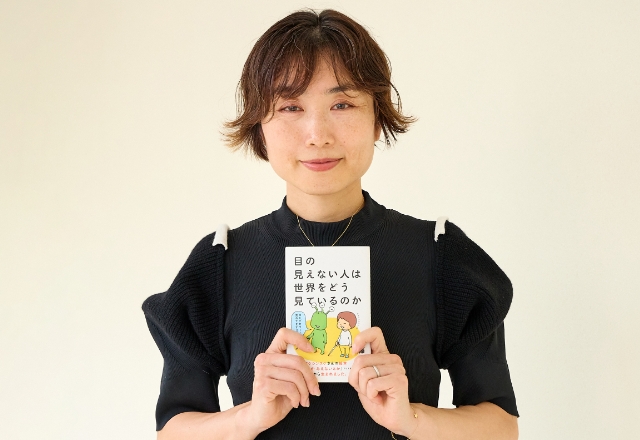
Asa Ito
Professor
Institute of Future Science / Institute for Liberal Arts
Institute of Science Tokyo*
Specializing in aesthetics and contemporary art, she originally aspired to become a biologist but switched to humanities in her third year of university. She is currently researching the nature of the human body through the lens of disability.
In 2010, she left the University of Tokyo’s Graduate School of Humanities and Sociology after completing coursework in the field of basic cultural studies, aesthetics and art studies. She received her PhD in Literature from the same university the same year. After serving as a special research fellow of the Japan Society for the Promotion of Science, she became an associate professor at the former Tokyo Institute of Technology’s Liberal Arts Center in 2013. She has held her current position since April 2016. From February 2020 to September 2024, she served as the founding director of the Tokyo Institute of Technology’s Future of Humanity Research Center.
* The Institute of Science Tokyo (Science Tokyo) was established on October 1, 2024, following the merger between Tokyo Medical and Dental University (TMDU) and the Tokyo Institute of Technology (Tokyo Tech).
I listened to people with visual impairment like a student learning from a teacher
― Can you describe the circumstances leading up to publication of your book? What motivated you to begin interviewing people with disabilities?
Personally, I’ve always felt more drawn to painting than music, and I remember things better when I read them than when I hear them spoken. I realized I rely heavily on my sense of sight. My initial motivation came purely from curiosity: “What would the world look like without this sense of sight?” I wanted to hear stories from people who could not see.
After that, the more I learned about people with visual impairment the more questions I’d never considered before began to surface. So, with the mindset of seeking guidance from a teacher, I spoke with various people, including Mr. Shigeo Yoshiwara, a Paralympic medalist affiliated with Santen. Their stories were so fascinating that I wanted to share them with others. I started creating and distributing my own “zine” (self-published booklet). I then compiled the content and took it to a publisher, which led to its publication.
As I mention in the book, I’ve been fascinated with living things since childhood and aspired to become a biologist. I had a desire to understand how the world appears to life forms with bodies that are different from my own. Currently, I study aesthetics—a discipline that attempts to articulate things we understand yet struggle to put into words. Within this field, I focus on the human body, seeking to reveal how our perception of the world differs based on our distinct physical forms.
Aesthetics is a philosophical discipline, but historically, philosophy has been dominated by white men from the middle and upper classes. Consequently, philosophy books to date have scarcely addressed the experiences of blind people or matters related to childbirth and childcare—experiences I myself have lived through. For me, an Asian woman, this naturally felt unreal, and I realized that what had been debated in the world of philosophy and written in books represented only a tiny fraction of the real world.
Behind my research on the body is an academic ambition: “If there’s so much being left unsaid in the world of philosophy, then I’ll take it upon myself to fill in the gaps.” Since I'm dealing with things not written in books, my research isn’t based on reading books—I actually go and talk to the people involved. I plan to continue these interviews and make them my life’s work.
The unexpected question: “Do people with visual impairment the visually impaired, share any common traits?”
― How have readers responded to the book?
The reactions of people with visual impairment who read How Do People Who Are Blind See the World? were interesting. The most common response was “I learned a lot!” At first I thought they were joking (laughs).
But in reality, even among people who are experiencing vision loss, how they perceive things and understand the world varies completely depending on whether they have low vision or total blindness, whether their blindness is congenital or acquired, and if acquired, at what age it occurred. Of course, differences in personalities and values also play a role. So when people with visual impairment read my book, they often discover, “Oh, so that’s how it is for other people!”
“Do people with visual impairment share any common traits?” I’ve been asked this directly by someone with the condition. Those with sight tend to lump people with low or no vision into a single category, but in reality, each person is completely different. As the author, that fact was shocking to me.
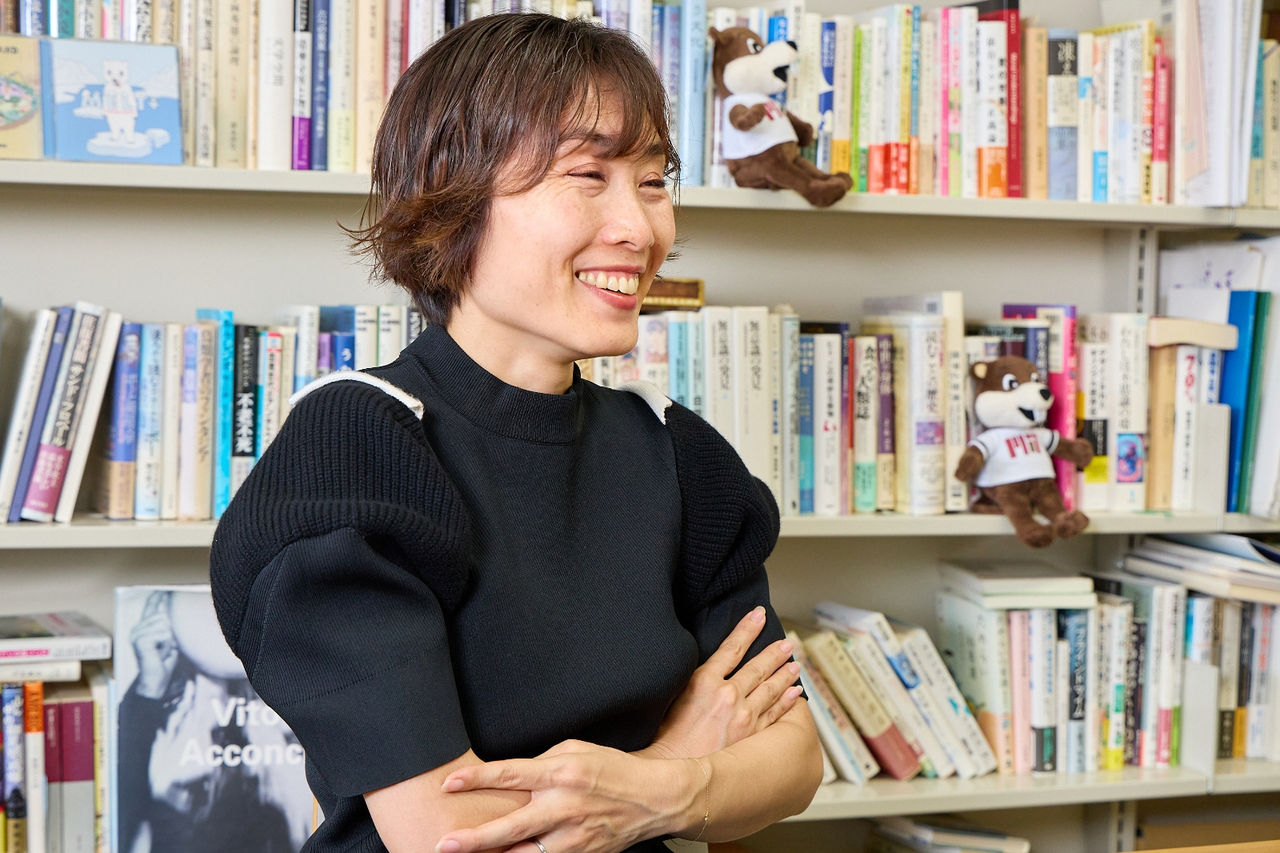
Sighted readers often mention the story of the four-legged chair and the three-legged chair when sharing their impressions of the book.
Most sighted people think of blindness as the state of lacking visual information, but the world of the person who is experiencing vision loss has a fundamental structure that does not rely on visual information. It's like the difference between a four-legged chair and a three-legged chair. If you remove one leg from a four-legged chair, it tilts and becomes an incomplete chair. But some chairs by design only have three legs. By adjusting the position of the legs, even a three-legged chair can be stable.
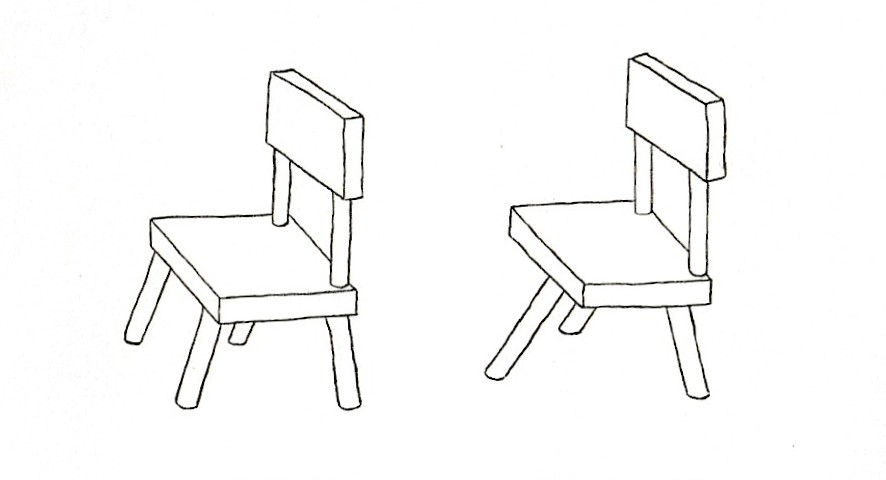
From Asa Ito, How Do People Who Are Blind See the World? Kobunsha, 2015, p. 30 Illustration: Ikuhiro Yamagata
Of course, since society is built for the sighted, it is essential to reduce the things that blind people cannot do through measures like installing tactile paving. These welfare initiatives still have room for improvement, so I believe society as a whole must continue working on them.
Even if the outcome—such as “reaching a destination”—is the same, the experience is entirely different for someone with sight who relies on their vision versus a person with visual impairment, person who relies on ambient sound and tactile cues like tactile paving. I wrote this book because I wanted to explore how the world is perceived from different perspectives, and the fascinating aspects of each different experience.
What if we dismantled the framework of the inclusive and included?
― At Santen, we are committed to realizing an inclusive society for people with visual impairment and fostering an environment where all employees can thrive. What do you think we should focus on moving forward?
To create an environment where diverse people can thrive, I believe the majority group itself must be dismantled. When we talk about inclusion, it’s often framed as “incorporating people with disabilities into the mainstream group of individuals without disability.” However, if the group of people who do not experience disabilities itself becomes fragmented, it naturally becomes easier for others to integrate.
For example, imagine a setting where everyone is seated facing forward, listening to a teacher. People who can’t maintain a seated posture would find it difficult to participate, and even if they did, they’d feel uncomfortable if they were the only one with a different posture. If from the start, however, people were sitting in chairs, sitting on the floor, or standing to listen—that is, if they were allowed a variety of postures—then the setting would become a place that’s easy for anyone to enter into and would be comfortable for everyone.
To create such an environment, it would be beneficial for people with disabilities to be included in positions with decision-making authority, such as management roles, or in a role responsible for setting the rules for the meeting, such as the facilitator.
If there was a person with visual impairment in management who always creates Word documents using their computer’s text-to-speech function, then I think that no one attending the meeting would ever create PowerPoint documents that are primarily visual. The presence of the disabled manager would help those around them realize that PowerPoint is an assistive technology for sighted people, similar to a white cane for the people with low or no vision.
When people have different physical abilities, achieving goals together requires ingenuity and compels people with and without disabilities to become creative. Little will change if the majority simply thinks, “Let’s make them do things our way.” However, if we reexamine the norms dictating “how one must behave in a given situation” and instead choose a variety of approaches to achieve our goals, then this could ultimately lead to greater inclusion.
― When working as a team alongside individuals with disabilities, is there anything you, as a leader, bear in mind?
The department I lead at the university also employs someone with a severe physical disability, and I’m always incredibly inspired by him. Of course, he’s highly capable and fully competent at his job, but his approach to work is different, and some aspects require special equipment. That’s why I constantly communicate our core philosophy—“what kind of organization we are”—to the university administration and our members to ensure they understand it. The organization I’m part of is focused on thinking about “what future society should be like,” so the perspectives of people with different physical conditions are absolutely essential.
Within the team, we share our philosophy and provide necessary support for members with disabilities, while also placing value on relationships that allow us to joke around, tease each other, and have normal conversations. Of course it depends on each individual’s specific needs, so it’s hard to generalize, but if you treat someone like they’re fragile, then you will end up treating them like a special guest. Rather than trying to force them into the group, treating them in a way that’s somewhat “casual” actually creates an atmosphere where they feel included. That’s why we include our colleague who experiences a disability in the gritty, hands-on work involved in running the organization, and make sure his disability is something we can talk about normally within the team.
― Efficiency is a factor in profitability, so it can be difficult to break away from the majority-minority dynamic. As a company, how should we address this conflict?
It’s difficult, isn’t it? Not just in Japan, but globally, “employment” remains a high barrier for people with disabilities. Hiring individuals with disabilities involves costs related to equipment and adapting work environments. Therefore, it’s understandable that companies are averse to taking risks when the benefits of hiring someone are unclear.
In that sense, I feel universities have a role to play in setting precedents. Universities are places where experiments can be conducted. If universities can produce research showing that hiring people with disabilities contributes to organizational growth, it might eventually spread to companies as well. I think there just aren’t enough experiments at the moment.
Diversity but inclusion. You can’t become friends simply by speaking your mind.
― What is essential for building organizations and societies that can harness the diversity of each individual going forward?
First, I think we need to pause and reflect on the phrase “diversity is important.” While recognizing each other’s differences is certainly valuable, it seems that today, acknowledging diversity has become a way to draw lines—“you and I are different”—and has turned into a reason to avoid engaging with one another. But what’s truly important is for diverse people to come together as colleagues and build a single organization or society, right?
In Japan, “diversity and inclusion” is often discussed as a set, the assumption being that you cannot have “diversity” without “inclusion.” However, these two concepts are fundamentally contradictory.
Taken to an extreme, diversity risks fracturing organizations and societies, so it must be addressed alongside inclusion. You could call it “Diversity but Inclusion.” Diversity and inclusion are always in a state of tension, requiring careful navigation to maintain balance. It won’t stabilize on its own; the balance shifts whenever a single member changes, demanding constant awareness.
While acknowledging differences is certainly important, if everyone insists on expressing their true feelings and opinions, we won't be able to come together as a team. Within companies, people have various employment statuses and differing levels of discretion, which can make things difficult. Within this context, the question is “How can each individual develop a sense of ownership toward the organization?” Based on common ideals and goals, and transcending individual positions, we need to create more opportunities to discuss what we want to be, with a certain tatemae*.
* The Japanese term tatemae refers to the public or socially acceptable face that people display, which may differ from their private feelings or true intentions.
After the interview
This dialogue considered the essence of diversity through differences in perceptions of people with vision and people with visual impairment, providing an opportunity to reexamine the very nature of “inclusion.” Santen, which seeks to realize a society where everyone can participate authentically, views diversity, equity and inclusion not as a temporary initiative, but as something to be cultivated within day-to-day relationships. To achieve “Happiness with Vision” for people around the world, Santen will continue to seek ways to walk together while respecting differences in perception.
Related pages